This Is Our River Kwai Moment
The Saturday Huddle is a weekly column that features opinion, analysis and reflections on Huddle stories, podcasts and business news in the region. Derek Montague is a Halifax-based reporter for Huddle.
I must admit I feel a lot like Colonel Nicholson these days, even though I have wielded little power these past weeks and months.
Yet within my small circles at work and in my social life, I supported the plan to lift restrictions, based solely on mental fatigue from two years of Covid, and that awful feeling of isolation we all had.
I didn’t support it for the same reasons the ignoramuses involved in the trucker’s convoy supported the removal of mandates. At no time did I delude myself into thinking we were somehow less free because society demanded we make a small personal sacrifice for the greater good.
But as a Huddle reporter, I had also seen the devastating economic effects the restrictions had on small businesses, while the larger box stores seemed immune to the worst punishments.
After these businesses owners were asked to lose so much over two years, after people with mental health issues suffered for so long silently, the timing seemed right, for oh so many reasons.
Now for those classic film plebs who didn’t get my reference to Colonel Nicholson in my lede or headline, let me regale you with a story of POWs, a bridge, and a river.
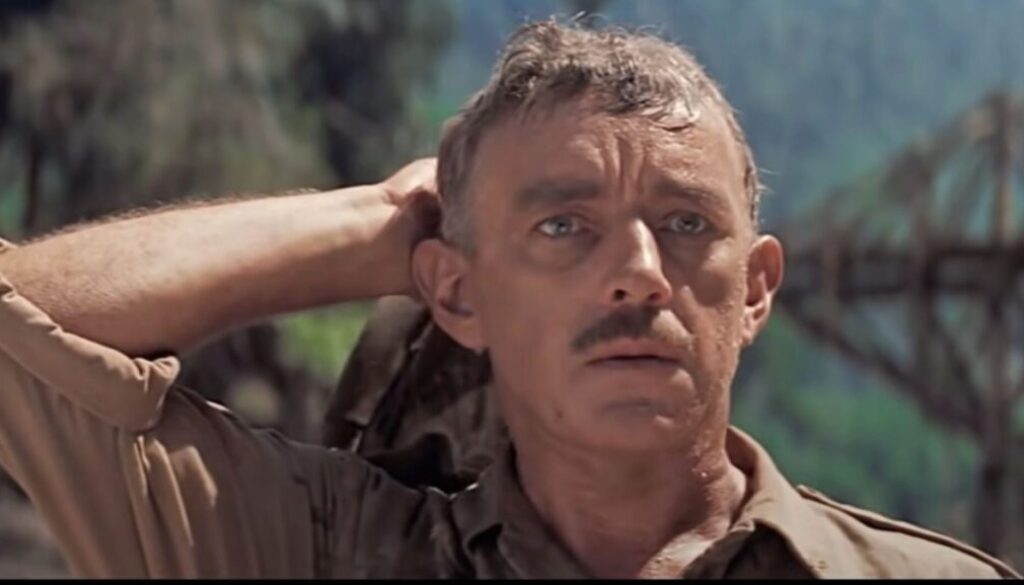
In the timeless classic The Bridge on the River Kwai, Nicholson (played brilliantly by Alec Guinness), is the leader of a large group of British POWs captured by the Japanese in World War II. The Japanese commander, Saito, puts the prisoners to work to build a vital railway bridge.
The construction of the bridge, led by Saito, is a disaster. Desperate, he puts the engineering in the hands of Nicholson and the British officers. In a strange twist, Nicholson begins taking pride in the building of the bridge, despite the fact he is aiding the enemy.
He justifies his actions by doing so many mental gymnastics he convinces himself, and others, that the bridge will act as a monument to British ingenuity and workmanship.
Then, at the climactic ending, Nicholson discovers that the allied forces have been planning to blow up the bridge, and the detonator was already set.
Rather than snapping out of his stupor and realizing the bridge needed to come down, he does everything in his power to prevent the detonation.
In his panic, he cost his fellow soldiers their lives. In one of the most iconic moments in film history, Nicholson, with regret and anguish on his face, looks at the chaos he helped create.
“What have I done?” he squeaks out, before his limp body falls, knowingly or unknowingly, onto the detonator in time to stop the train from crossing.
Talking to others the past two weeks, a lot of people who supported the lifting of mandates are having their River Kwai moment, wondering why on earth they supported something that is now so clearly foolish.
To make sure I was up to date on the latest info, I Googled some articles from New Brunswick and Nova Scotia related to the latest Covid surge. The headlines alone are enough to give you a Nicholson-like look of anguish before collapsing.
- “39 long-term care facilities in N.S. dealing with COVID-19 outbreaks” (CBC)
- “Long a pandemic leader, Nova Scotia is now a COVID-19 hot spot” (CBC)
- “Lab official fears new normal of health staff absences if COVID not controlled” (CBC)
- “New Brunswick reports 10 deaths related to COVID-19; cases continue to rise” (CTV)
- “Pandemic effects on health care the worst yet, say N.B. doctors and nurses” (CBC)
Reading such headlines made me feel like yet another colonel from a timeless war movie: Colonel Kurtz from Apocalypse Now.
“The horror; the horror.”
Fitting that, when Kurtz is recounting how he discovered the genius of horror, he describes vaccinating children in a small village.
I shan’t describe what happens to those children in case you are eating your breakfast while reading this.
Meanwhile, our political leaders, who once did an admirable job making decisions based on science are now reducing themselves to half measures and mixed messaging.
It’s important to keep wearing masks, but we won’t make it a law anymore.
In Nova Scotia, we will make a special mask mandate for schools. Makes sense, classrooms are crowded, and our children are vulnerable. But what about everyone else in our society that is vulnerable? To hell with them, I guess.
In New Brunswick, according to a CTV article, the government is about to welcome back unvaccinated healthcare workers, at a time of record-high Covid numbers.
This is a madness few movie quotes can describe. Politics based on science lasted a brief two years.
Once again, many small businesses have filled the void. There are also headlines of entrepreneurs in our cities introducing their own mask and other health mandates, at the risk of, once again losing more money.
This creates a patchwork system, where those who feel vulnerable to illness can only feel safe some of the time, in select places. This is not a system designed to protect those most at risk or combat a major wave of Covid.
I don’t know what the correct balance is anymore. I do believe something as simple as a mask mandate should be universal. I don’t care what the crackpots say, wearing a thin piece of cloth is not suffocating and doesn’t reduce our “freedoms.”
What I still have mixed feelings about are the restrictions that cause mental harm (like isolation) and economic disaster to small businesses. I wouldn’t be able to tell a small businesses owner, who wracked up $60,000 in CEBA Loans and other debts, that they should take on more.
We as taxpayers also can’t afford to foot the bill for economic suffering. Look at the national debt. Look at the disastrous deficits that have been announced by every province this budget season.
All I know is a complete lifting of health mandates is not working. The scientific proof is undeniable.
Based on the mixed messaging and half measures, no one in power is willing to blow up the bridge we just finished building a few weeks ago. It’s too beautiful, took too long to build; who cares if it aids the enemy we’ve been fighting for two long years?
It’s our big monument to feeling normal that will last generations.
What have we done, indeed.
Feedback? E-mail Derek Montague: [email protected]