Atlantic Canadian Publishers Plagued By Paper Shortages, Supply Chain Disruptions
HALIFAX — Mill closures, paper shortages, and supply chain disruptions have combined to create a “perfect storm” that’s sending waves of delays and uncertainty crashing across Atlantic Canada’s publishing industry.
Julie Scriver, the creative director at Fredericton’s Goose Lane Editions, says the pressure on local publishers has been building since the start of the pandemic, but that things have become especially bad over the last three to five months.
“The supply chain is profoundly compromised, and it’s not getting better,” she says.
Over the last five years, several paper mills shut down. It left only a few mills that could supply paper for the pages in a book. The pandemic has only accelerated that trend.
Closing paper mills are constricting the supply of paper on the market, driving up prices.
Meanwhile, the printing companies that actually put books together are scrambling to keep up with demand from publishers, while managing a limited paper supply.
The result is a juggling act that’s causing massive delays that are rippling through the entire industry.
Scriver says Goose Lane could once get printing jobs done in four to five weeks. Now, she has suppliers telling her they won’t be able to get products to her for six months.
That’s a big problem for an industry that typically plans books releases far in advance.
Scriver says Goose Lane has had to completely overhaul its process for taking a book from idea to manuscript to physical book on a store shelf.
“It really requires a mammoth shift in planning concept because the timelines and the responsiveness of our suppliers are just really curtailed by the domino effect of the pandemic,” she says.
But that’s just the longer-term issue.
No room for flexibility
In the short term, Scriver’s days are now typically swallowed by endless cajoling with printing companies as she tries to snag a spot for her print runs.
“I’m in the hot seat trying to pull the rabbit out of the hat,” she says.
The publishing industry operates under a bizarre set of rules that let booksellers return any books they don’t sell back to publishers, without paying for them. So publishers aim to print enough just books to meet the demand for a title.
“Our objective is to not have a warehouse full of books a year or two or three after publication [because] they’re generally not worth much after that,” Scriver says.
But long turnarounds at the printers mean publishers can’t be responsive with reprints if one of their books catches on.
Scriver says one of Goose Lane’s books has just been nominated for a prestigious award and she will struggle to get more printed if it wins.
“There’s no guarantee there will be paper to meet our reprint, or that I will be able to find a printer who has space in their production line to print those copies in order to meet the appetite for a book that just won this big prize,” she says.
Demand is high, but local publishers can’t cash in
Alex Liot is the interim CEO at the Atlantic Publishers Marketing Association. He says not having copies of a book to put in front of people at bookstores is a huge deal.
The APMA’s data shows most Atlantic Canadians think the local publishing industry is important. However, most (even the ones that believe in it) won’t specifically seek out a local book.
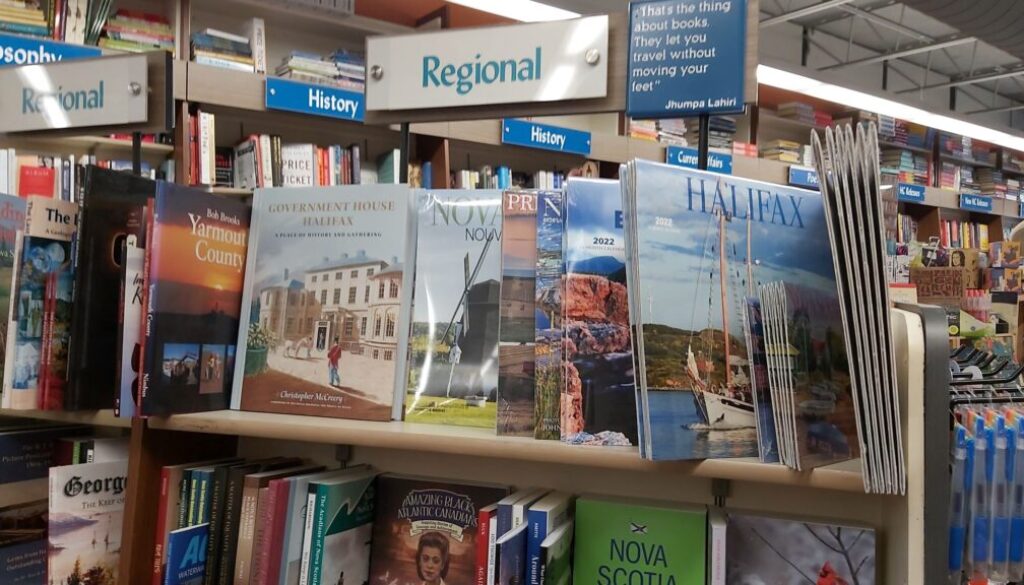
That makes it vital for Atlantic Canadian publishers to get their books in front of people at brick-and-mortar bookstores.
“I don’t believe that the connection to local books is so strong that [consumers] just go find another local book; if you really wanted one on, you know, knitting and your local knitting book isn’t there, but the other one is, you’re probably going to buy that other one,” Loit says.
He says the cascading problems caused by paper shortages and supply chain disruptions are threatening local publishers’ ability to get their books in stores and in front of consumers.
That’s even more true this year when people are shopping for the holidays earlier than normal.
“We’re seeing upward pressure in terms of demand, yet we’re dealing with supply chain issues on the other side. So, what happens when somebody can’t get that book that they want?” he asks.
“Any disruption in the supply chain and the unavailability of a local book to be purchased creates a lost opportunity for growth.”
Things could get worse before they get better
Many in the publishing industry expect the disruptions to persist well into next year — maybe longer, and possibly get worse before they’re over.
Scriver says that, while it has been challenging, the pressure has had a small “silver lining.”
Goose Lane and other Atlantic Canadian publishers have had to “rethink and reimagine what the experience of our audience could be, and how to make that happen,” she says
The industry is adapting, finding new ways to engage its audience and get people reading its books. Those changes will last long after the pandemic has waned.
Trevor Nichols is a Huddle reporter in Halifax. Send him your feedback and story ideas: [email protected].